AMC 8 2022 Problem 25
AMC8 2022 年第 25 题
概率★★★★★
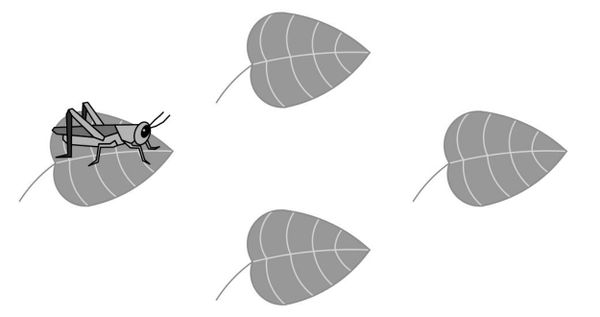
A cricket randomly hops between 4 leaves, on each turn hopping to one of the other 3 leaves with equal probability. After 4 hops what is the probability that the cricket has returned to the leaf where it started?
一只蟋蟀随机地在 4 片叶子之间跳来跳去,每次都以相同的概率跳到其它的 3 片叶子上。问经过 4 次跳跃,蟋蟀回到它开始的那片叶子的概率是多少?
- A.
- B.
- C.
- D.
- E.
正确答案 · Correct Answer
E
解析 · Solution
解法1
先把结构想清楚:4 片叶子分两类——你此刻站的那片(起点 S),和其余 3 片(它们地位完全一样,统称「其他叶」)。每一步必离开当前那片,等概率(各 )落到另外 3 片之一。问 4 步后回到 S 的概率。抓住「3 片其他叶完全等价」这个对称,是这题所有巧解的根。
三种解法殊途同归,都得 :解法1 最朴素(把回到 S 的路线算出来),解法2 用对称只看第 3 步,解法3 把它压成两态逐步推。
解法1(常规解法·数路线)
第 1 步一定离开 S,落到某片其他叶(记作 O)。要 4 步回到 S,从 O 出发的后 3 步只有两条走法。下面两种写法结果一样。
写法一(算概率):
路线①「中途先回一次」 S→O→S→O→S:(回 S;再出去必落到某片其他叶,概率 1;再回 S)。
路线②「一直在外面绕」 S→O→O→O→S:(两次都留在其他叶,各 ;最后回 S)。
两条互斥,合计 。
写法二(数个数):
每条具体的 4 步路线概率都是 ,共 条;只要数出回到 S 的有几条。
路线①型 S→O→S→O→S:第 1 步挑其他叶(3 种)、第 2 步必回 S(1 种)、第 3 步再挑其他叶(3 种)、第 4 步必回 S(1 种)→ 条。
路线②型 S→O→O→O→S:第 1 步挑其他叶(3 种)、第 2,3 步都要留在其他叶(各 2 种,去掉 S)、第 4 步必回 S(1 种)→ 条。
第 2 步只有「回 S」或「不回 S」两种,正好对应①②,不重不漏;共 9+12=21 条 → 。
易错点:第 1 步「离开 S」是必然事件(概率 1),别多乘一个 ;两条回程别只想到②(一直在外)而漏了①(中途先回)。
巧解·盯住第3步
不追全程,只问:第 3 步之后蟋蟀在不在 S?
3 步回到 S 的路线是「先后踏两片不同的其他叶再回」:第 1 步 3 选 1、第 2 步换一片其他叶 2 选 1、第 3 步回 S,共 3×2=6 条;而 3 步路线共 条。
所以第 3 步后在 S 的概率 ,不在 S 的概率 。
第 4 步:若此刻在 S,下一步必离开、回不了 S;若在任何一片其他叶上(概率 ),都有 跳回 S。所以答案 。
这里用了对称:3 片其他叶完全等价,所以「不在 S」可整体算 、统一乘 ,不必分别追是哪片——这是最省力的一步。
进阶·两态递推
把 4 片叶子压成「在 S/不在 S」两种状态:要某一步停在 S,必须上一步不在 S、再以 跳回。下面口语版已够用,进阶版给出公式。
口语版(不写公式也能做):
每一步「在 S 的概率」=「上一步不在 S 的概率」,逐步算:
第 1 步:必离开 S → 0。
第 2 步:上一步必不在 S(概率 1)→ 。
第 3 步:上一步不在 S 的概率 → 。
第 4 步:上一步不在 S 的概率 → 。
进阶版(写成公式):
记 为第 步在 S 的概率、。看上一步(第 n-1 步)分两种情形:
若上一步在 S(概率 )→ 这一步必离开,对「在 S」贡献 0;
若上一步不在 S(概率 )→ 这一步有 跳回。
两种情形相加:
滚动得 。这条公式属竞赛进阶,能推出口语版就够,不必强记。
前置(按需补):全程只用两条最基本的概率规则——「沿一条路把每步概率相乘」「不同(互斥)路线的概率相加」;再加一个关键观察——3 片其他叶完全等价(对称),可合并成一个「不在 S」状态。解法3 的递推公式属竞赛进阶,不是必需。
Solution 1
*(Elementary — count the paths back to the start.)* First the structure: the 4 leaves split into two kinds — the leaf you are on (start ) and the other 3 (all interchangeable, call any of them ). Each hop must leave the current leaf, landing on one of the other 3 with probability each. The first hop always leaves for some ; to be back at after 4 hops, the last 3 hops from follow only two routes. Two ways to finish, same result.
Way 1 (multiply probabilities):
Route ① "dip back once" : (back to ; out to some with probability 1; back to ).
Route ② "stay out" : (stay among the other leaves, each; then return).
Mutually exclusive: .
Way 2 (count the paths):
Every specific 4-hop path has probability , and there are ; just count those returning to .
Route-① type : hop 1 picks an (3), hop 2 back to (1), hop 3 picks an (3), hop 4 back to (1) .
Route-② type : hop 1 picks an (3), hops 2,3 stay off (2 each, dropping ), hop 4 back to (1) .
After hop 2 the cricket is back at or not — exactly Routes ① and ②, no overlap or gap; so 9+12=21 and .
Trap: the first hop leaving is certain (probability 1) — don't multiply an extra ; and don't forget Route ① (many see only Route ②).
*(Slick — look at hop 3, use symmetry.)* Instead of the whole trip, ask: after 3 hops, is the cricket at ?
A 3-hop return visits two different other leaves and comes back: 3 choices for the first, 2 for the second, 1 to return =6 ways, out of total. So , and the probability of NOT being at is .
On hop 4: from you cannot reach , but from any other leaf you return with probability . So the answer is .
The symmetry — all 3 other leaves are equivalent — is what lets us lump "not at " into one and multiply by a single .
*(Advanced — two-state recurrence; the plain version is enough.)* Compress the 4 leaves into two states, "at " / "not at ": to be at on a hop you must have been off the hop before, then jump back with probability . The plain version below suffices; the formula version follows.
Plain version (no formula needed):
(probability at this hop) = (probability off last hop) . Step along:
Hop 1: must leave → 0.
Hop 2: last hop is surely off (probability 1) → .
Hop 3: off last hop with probability → .
Hop 4: off last hop with probability → .
Formula version:
let be the probability of being at after hops, . Look at the previous hop:
if at (probability ) → this hop must leave, contributing 0;
if off (probability ) → this hop returns with probability .
Adding the two cases:
which rolls to . The closed recurrence is competition-level — the plain version is all an AMC8 student needs.
继续练习