AMC 8 2025 Problem 21
AMC8 2025 年第 21 题
鸽巢原理与策略★★★★☆
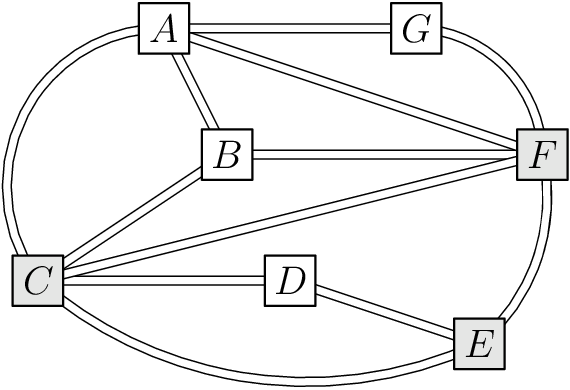
The Konigsberg School has assigned grades 1 through 7 to pods through , one grade per pod. Some of the pods are connected by walkways, as shown in the figure below. The school noticed that each pair of connected pods has been assigned grades differing by 2 or more grade levels. (For example, grades 1 and 2 will not be in pods directly connected by a walkway.) What is the sum of the grade levels assigned to pods C, E , and ?
哥尼斯堡学校将1至7年级的学生分配到A至G教学区,每个教学区分配一个年级。如下图所示,部分教学区通过走廊相连。学校注意到,每两个相连的教学区分配的年级数之差不低于2(例如,1年级和2年级的教学区不会直接通过走廊相连)。请问,分配到C、E和F教学区的年级数总和是多少?
- A.12
- B.13
- C.14
- D.15
- E.16
正确答案 · Correct Answer
A
解析 · Solution
解法1
常规解法·先锁死最挤的两个区
先把条件说成人话:有走廊相连的两个区,年级差必须至少 2——题面例子说了,1 年级和 2 年级不会直接相连。
第一步,数每个区连了几条走廊: 连 、、、、 五条, 连 、、、、 五条,是全图最挤的两个区; 只连 、, 只连 、,最清闲。
第二步,最挤的区只能放最「极端」的年级。假如 放中间某个年级 ( 之一),那么 g-1 和 g+1 都不能出现在 的邻居里; 去掉 g,g-1,g+1 只剩 4 个年级,却要填 5 个邻居——不够分,矛盾。所以 只能是 1 或 7, 同理;、 相连、差 6 合法,故 。两种取法完全对称(把每个年级 换成 8-g 即互换),最后求的和一样,不妨设 C=1、F=7。
第三步,安置最怕极端的 6 和 2。6 与 7 只差 1,绝不能和 相连;全图只有 不和 相连,所以 D=6。同理 2 不能和 相连,只有 不和 相连,所以 G=2。
第四步,剩下 3、4、5 分给 、、。 和 相连,所以 ;、 相连,3、4、5 里差 的只有 3 和 5 这一对,所以 ,于是 A=5、B=3,E=4。
收尾把每条走廊核一遍(差都 )。C+E+F=1+4+7=12,选 A。
易错提醒:条件别读松了——是「差至少 2」,不是「差 1 就行」;最后求的是 、、 三个区,手滑把 数进来(1+6+7=14)正好撞上干扰项 C。
巧解·越极端越不挑邻居
年级越靠中间,忌讳的邻居越多(两侧各差 1 的都不行);越极端越好相处。所以连走廊最多(各 5 条)的 、 必须让给两个极端 ;紧挨极端的 6 和 2 也各只有一个安身处——全图唯一不邻 的 放 6、唯一不邻 的 放 2。1、2、6、7 就位后,中段 3、4、5 里相邻的 、 只能岔开成 (且 邻 G=2 排除 3,得 A=5、B=3), 被挤成 4。C+E+F=1+4+7=12。
整个安排其实是唯一的(至多差一个 的整体翻转),所以三区之和没有第二种可能。
前置:不需要任何图论知识——全程只用「数一数每个区连了几条走廊」和排除法。
Solution 1
*(Elementary — pin down the two busiest pods first.)*
Read the condition carefully: pods joined by a walkway must have grades differing by at least 2 — the example says grades 1 and 2 can never be directly connected.
Step 1, count walkways at each pod: connects to , , , , (five) and connects to , , , , (five) — the busiest two; (only , ) and (only , ) are the quietest.
Step 2, the busiest pods must take the most extreme grades. If held a middle grade (one of ), then g-1 and g+1 would be banned from all its neighbors; removing g,g-1,g+1 from leaves only 4 grades for 5 neighbors — impossible. So , likewise ; they are connected (difference 6, allowed), hence . The two choices are symmetric (swap every grade for 8-g), so assume C=1, F=7.
Step 3, place 6 and 2. Grade 6 differs from 7 by only 1, so it cannot neighbor ; the only pod not adjacent to is , hence D=6. Likewise 2 cannot neighbor , and only is not adjacent to , so G=2.
Step 4, grades 3, 4, 5 remain for , , . Since neighbors , ; since , are adjacent, the only pair among 3, 4, 5 differing by is , so A=5, B=3, and E=4.
Check every walkway (all differences ). C+E+F=1+4+7=12, answer A.
Watch out: the condition is "differ by at least 2," not "at least 1"; and the question asks for , , — accidentally including gives 1+6+7=14, exactly trap choice C.
*(Slick — the more extreme, the less picky.)*
Middle grades have two forbidden neighbors (one on each side); extreme grades have only one. So the two pods with 5 walkways each, and , must take the extremes ; the near-extremes 6 and 2 each have a single safe home — 6 goes to , the only pod not adjacent to , and 2 goes to , the only pod not adjacent to . With 1, 2, 6, 7 placed, the adjacent pair , must split the middle as (and neighbors G=2, ruling out 3, so A=5, B=3), squeezing E=4. Hence C+E+F=1+4+7=12.
The whole assignment is unique up to the global flip , so the sum has no second possibility.
Prerequisite: no graph theory needed — the whole solution is "count each pod's walkways" plus elimination.
继续练习