AMC 8 2025 Problem 25
AMC8 2025 年第 25 题
排列与组合★★★★★
Makayla finds all the possible ways to draw a path in a diamond-shaped grid. Each path starts at the bottom of the grid and ends at the top, always moving one unit northeast or northwest. She computes the area of the region between each path and the right side of the grid. Two examples are shown in the figures below. What is the sum of the areas determined by all possible paths?
Makayla在一个5×5的菱形网格中找到了所有可能的绘制路径的方式。每条路径从网格底部开始,到网格的顶部结束,总是朝东北或西北方向移动一个单位。她计算了每条路径与网格右侧边缘之间的区域面积。下图展示了两个示例。请问所有可能路径与网格右侧边缘之间的区域面积之和是多少?
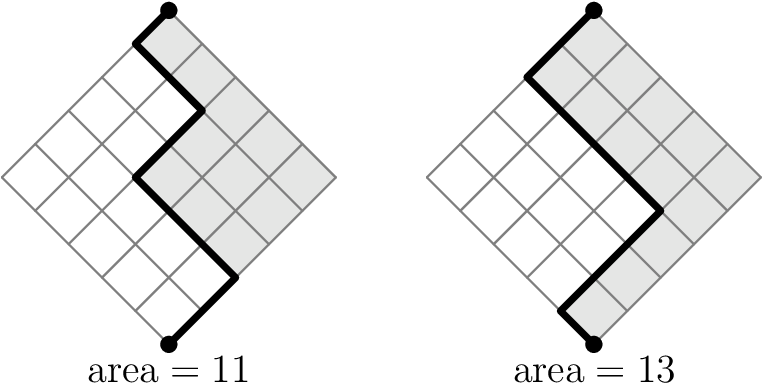
- A.2520
- B.3150
- C.3840
- D.4730
- E.5050
正确答案 · Correct Answer
B
解析 · Solution
解法1
先把题意说清楚:5×5 的菱形格(一共 25 个小方格),从最下面的顶点出发、走到最上面的顶点,每步只能朝右上(NE)或左上(NW),共 10 步。每条路径把菱形切成左右两块,题目要的是「路径右边那块」的面积,并对所有路径求和。
三种解法都得 3150(外加一种仅供参考的进阶法):解法1 最直观(配对),解法2 换坐标看(转成方格),解法3 是竞赛常用的双重计数。
解法1(常规解法·配对求和)
先数路径条数:10 步里挑哪 5 步走 NE(其余自动是 NW)就定下整条路径,所以共 条。
关键一招是「配对」:把整张菱形旋转 (等价于把每步 NE↔NW 对换),一条路径就变成另一条。菱形共 25 个格,一条路径右边那块若面积为 ,左边那块就是 25-A;旋转 后,原来的左块正好转到右边——所以它的「姐妹路径」右块面积恰是 25-A。
(上图:左边路径右块面积 11,旋转 成右边那条、右块面积 14,两者合 25。)
于是 252 条路径两两成对,每对面积和都是 25,共 对,总面积 =126×25=3150。
易错点:求的是全部 252 条路径的面积「之和」,不是单条;配对时每对只算一次(126 对),别写成 252×25(那把每条重复数了一遍)。
巧解·转成方格 + 平均高度
把菱形顺时针转 ,就成了普通的 5×5 方格:路径从左下角 (0,0) 走到右上角 (5,5),每步向右或向上、各 5 步。这时「右块面积」正好等于每个「向右」步所在的高度之和。
路径条数也能这么数:5 个向右步的高度可取 共 6 个值、可重复且不减,用隔板法得 ,与解法1 一致。
求和用对称:每条路径都有一条镜像路径,把每个高度 换成 5-y;所以单个高度的平均是 。每条路径有 5 个高度,平均面积 ;乘以 252 条,总面积 。
进阶·双重计数
仍用方格模型,把 5 个向上步记作 、5 个向右步记作 。一个 步的高度 = 它前面已出现的 的个数,所以一条路径的面积 =「 排在 前面」的 (N,E) 对数。
换个角度数同一件事:5 个 和 5 个 共有 5×5=25 个 (N,E) 对。对任意一对,由对称性恰好一半的路径里 在 前,所以平均每条路径有 的面积。乘以 252 条,总面积 。
进阶·仅供参考
以下用到大学的母函数(q-模拟),中学不必掌握,仅列思路:把格路径按面积加权求和,有 (q-二项式);对它关于 求导再令 q=1,即得所有路径的面积之和 3150。
前置(按需补):解法1 要会组合数 (从 10 个里选 5 个的方法数);解法2 的隔板法、解法3 的双重计数都是组合计数常用招式。三种巧解共同的关键都是「对称配对」——把面积 与 25-A 凑成一对。
Solution 1
*(Elementary — pair them up.)* First count the paths: choosing which 5 of the 10 steps go NE (the rest are NW) fixes the path, so there are .
The key trick is pairing. Rotate the whole diamond (equivalently, swap every step NE↔NW): one path turns into another. The diamond has 25 unit cells; if a path's right region has area , its left region is 25-A, and the rotation turns the old left region into the new right region — so the partner ("sister") path has right-region area 25-A.
(Above: the left path has right-area 11; rotated it becomes the right path with right-area 14; together 25.)
So the 252 paths split into pairs, each summing to 25: total =126×25=3150.
Watch out: this is a sum over all 252 paths, and each pair is counted once (126 pairs) — don't write 252×25, which double-counts.
*(Slick — turn it into a square grid, then average.)* Rotate the diamond into an ordinary 5×5 square grid: paths run from (0,0) to (5,5) using right and up steps, 5 each. Now the right-region area equals the sum of the heights at which the 5 right-steps occur.
Count the paths this way too: each right-step's height is one of (6 values), chosen non-decreasingly with repeats — stars-and-bars gives , matching Solution 1.
Sum by symmetry: every path has a mirror that sends each height , so one height averages . Each path has 5 heights, so its average area is ; times 252 paths gives .
*(Advanced — double counting.)* Still in the square model, write the 5 up-steps as and the 5 right-steps as . An -step's height equals the number of 's already before it, so a path's area equals the number of (N,E) pairs with before .
Count the same total another way: the 5 's and 5 's form 5×5=25 pairs (N,E). For any fixed pair, by symmetry exactly half of all paths have before , so the average area per path is . Times 252 paths: .
*(Advanced — for reference only.)* This uses college-level generating functions (the -analog) and is not needed in middle school. Sketch: weighting lattice paths by area gives (the -binomial); differentiating in and setting q=1 yields the total area 3150.
继续练习