AMC 8 2026 Problem 25
AMC8 2026 年第 25 题
四边形与多边形★★★★★
In an equiangular hexagon, all interior angles measure 120°. An example of such a hexagon with side lengths 2, 3, 1, 3, 2, and 2 is shown below, inscribed in equilateral triangle ABC. Consider all equiangular hexagons with positive integer side lengths that can be inscribed in △ABC, with all six vertices on the sides of the triangle. What is the total number of such hexagons? Hexagons that differ only by a rotation or a reflection are considered the same.
在一个等角六边形中,所有内角均为 120°。下图展示了一个边长依次为 2、3、1、3、2、2 的例子,它内接于一个等边三角形 ABC 中。考虑所有边长为正整数、且六个顶点都在 △ABC 三边上的等角六边形。若两个六边形仅通过旋转或反射重合,则视为相同。这样的六边形共有多少个?
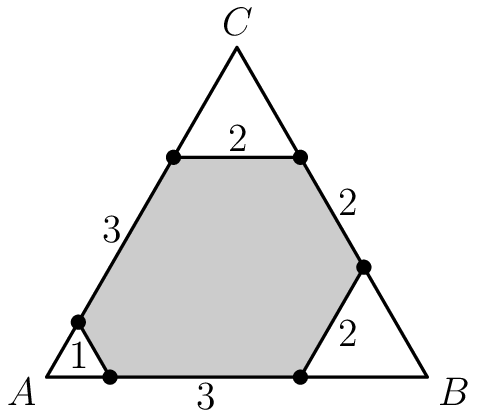
- A.4
- B.5
- C.6
- D.7
- E.8
正确答案 · Correct Answer
E
解析 · Solution
解法1
常规解法·倒过来想——从大三角形切三个角
第一步,看清结构。等角六边形每个内角 ,六个顶点都在 的三条边上,所以三角形每个角落都被「切掉」一个小三角形:小三角形在 顶点处的角是 ,在六边形顶点处的两个角都是 ——三个角全是 ,每个切下来的角都是等边三角形。设三个切角的边长为正整数 、、。
第二步,定大三角形的边长。沿 的一条边看:切角 +六边形贴边的一条边+切角 =三角形边长。用题面例子(边长依次 2、3、1、3、2、2)验证:相邻三条边之和 2+3+1=6,所以 边长为 6。六边形六条边依次是
(例子对应 (x,y,z)=(2,1,2):代入得 2、3、1、3、2、2 ✓)
第三步,列规矩。六条边都要是正整数:,且 等三条——即任意两个切角之和 。
第四步,按「最大的切角」分类枚举。旋转、翻转算同一个六边形,等于只看 这组数、不管顺序:
最大 =1:(1,1,1)——1 种
最大 =2:(2,1,1),(2,2,1),(2,2,2)——3 种
最大 =3:另两个只能取 1 或 2(3+3=6>5 犯规):(3,1,1),(3,2,1),(3,2,2)——3 种
最大 =4:另两个只能取 1(4+2=6>5):(4,1,1)——1 种
最大 :连最小搭配 5+1=6 都犯规,无解
合计 1+3+3+1=8 种,选 E。
易错提醒:约束是两切角之和 而不是 ——等于 6 时贴边那条边长变 0,两个切口撞在一起,六边形退化;另外 (3,2,1) 和 (1,2,3) 转一转、翻一翻就是同一个,按从小到大只记一次。
规范写法·设未知数列不等式
设三个切角边长为正整数 、、,六边形六边为 6-x-y,\ y,6-y-z,\ z,6-z-x,\ x,全部 等价于
旋转与翻转只是把 (x,y,z) 打乱顺序,所以数无序组即可。设 ,三条不等式里只有 起作用:
x=1:(1,1,1),(1,1,2),(1,1,3),(1,1,4),(1,2,2),(1,2,3)——6 组
x=2:(2,2,2),(2,2,3)——2 组
:,无解。
共 8 组,每组对应一个互不全等的六边形,选 E。
前置(等角六边形的万能起手式):把等角六边形的第 1、3、5 条边延长,三条线两两成 角、围出一个等边三角形——「每个等角六边形都是等边三角形切掉三个角」,处理 六边形先想它。
Solution 1
*(Elementary — think backwards: cut three corners off the big triangle.)*
Step 1, see the structure. An equiangular hexagon has all interior angles , and its six vertices lie on the three sides of , so each corner of the triangle gets cut off by a small triangle. That small triangle's angles are (at the triangle's vertex) and at each hexagon vertex — all three angles are , so every cut-off corner is an equilateral triangle. Let the three cut sizes be positive integers , , .
Step 2, find the big triangle's side. Along one side of : cut + one hexagon side + cut = the triangle's side. Check with the example (side lengths 2, 3, 1, 3, 2, 2): three consecutive sides sum to 2+3+1=6, so has side 6. The hexagon's sides, in order, are
(the example is (x,y,z)=(2,1,2): substituting gives 2, 3, 1, 3, 2, 2 ✓)
Step 3, the rules: all six sides are positive integers, so and each of 6-x-y, 6-y-z, 6-z-x is — that is, any two cuts sum to at most 5.
Step 4, classify by the largest cut. Rotations and reflections give the same hexagon, so only the multiset matters:
largest =1: (1,1,1) — 1 way
largest =2: (2,1,1),(2,2,1),(2,2,2) — 3 ways
largest =3: the others can only be 1 or 2 (since 3+3=6>5): (3,1,1),(3,2,1),(3,2,2) — 3 ways
largest =4: the others must be 1 (4+2=6>5): (4,1,1) — 1 way
largest : even the smallest pairing 5+1=6 breaks the rule
Total 1+3+3+1=8, choice E.
Watch out: the constraint is "any two cuts sum to ," not — at 6 the side between them shrinks to 0 and the two cuts collide, degenerating the hexagon; also (3,2,1) and (1,2,3) become the same hexagon after a rotation or reflection — record each sorted triple once.
*(Standard write-up — variables and inequalities.)*
Let the cut sizes be positive integers , , . The hexagon's sides are 6-x-y,\ y,6-y-z,\ z,6-z-x,\ x, and all is equivalent to
Rotations and reflections merely permute (x,y,z), so count unordered triples. Take ; then only binds:
x=1: (1,1,1),(1,1,2),(1,1,3),(1,1,4),(1,2,2),(1,2,3) — 6 triples
x=2: (2,2,2),(2,2,3) — 2 triples
: , impossible.
Total 8, each giving a non-congruent hexagon: choice E.
Prerequisite (the go-to move for equiangular hexagons): extend sides 1, 3, and 5 — the three lines meet at angles and enclose an equilateral triangle. "Every equiangular hexagon is an equilateral triangle with three corners cut off" is the standard opening for hexagon problems.
继续练习