AMC 8 2018 Problem 19
AMC8 2018 年第 19 题
基本计数原理★★★☆☆
In a sign pyramid a cell gets a "+" if the two cells below it have the same sign, and it gets a "-" if the two cells below it have different signs. The diagram below illustrates a sign pyramid with four levels. How many possible ways are there to fill the four cells in the bottom row to produce a "+" at the top of the pyramid?
在一种符号金字塔中,如果下面 2 个方块的符号相同,那么这 2 个方块上面的方块就得到一个"+"号;若下面 2 个方块的符号不同,那么这 2 个方块上面的方块就得到一个"-"号。 下图展示了一个 4 层的符号金字塔。为了使得金字塔的最顶层是个"+",那么最底层的 4 个方块有多少种赋予符号的方法?
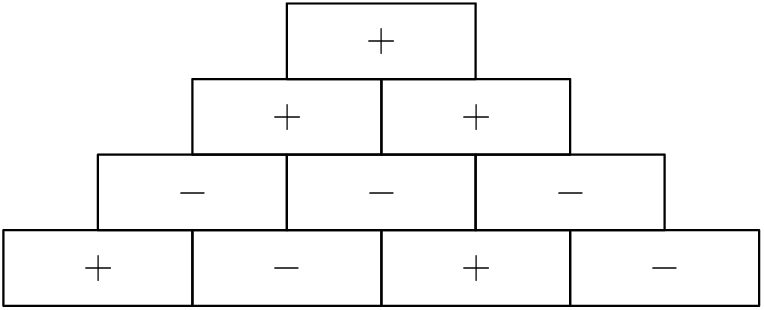
- A.2
- B.4
- C.8
- D.12
- E.16
正确答案 · Correct Answer
C
解析 · Solution
Solution 1
You could just make out all of the patterns that make the top positive. In this case, you would have the following patterns: +−−+, −++−, −−−−, ++++, −+−+, +−+−, ++−−, −−++. There are 8 patterns and so the answer is 8. -NinjaBoi2000
The top box is fixed by the problem. Choose the left 3 bottom-row boxes freely. There are ways. Then the left 2 boxes on the row above are determined. Then the left 1 box on the row above that is determined Then the right 1 box on that row is determined. Then the right 1 box on the row below is determined. Then the right 1 box on the bottom row is determined, completing the diagram. So the answer is 8.
The pyramid is built on the basic 3 blocks pattern: one above and two below. The basic pattern has four possible symbols and half of them have a on the above, half of them have a above. So, for the lowest layer with 4 blocks, there are possible combinations and half of them will lead to a (or ) on the top. The answer is . If you notice this rule, you can give the answer whatever how many layers you have. The answer will be for the layer with blocks., Casework We can use casework to solve this problem. The only way for the top cell to have a in it is if the third row of the pyramid (the one with 2 cells) is either or . First, let's pretend that the third row of the pyramid is . The only way for that to happen is if the second row (the one with 3 cells) is --- or . Now, let's pretend that the second is . That would have 2 possibilities for the first row (the one with 4 cells), and . Next, let's pretend that the second row is ---. That makes two more possibilities for the first row, and . Now, let's pretend that the 3rd row is , which means that the second row is either or . You will soon find that find 2 possibilities for the first row, or , and 2 possibilities for , and . Together, we find that the answer is 2+2+2+2=8. There are two choices for the uppermost: or . There are 16 cases in total ( ). Half of 16 is 8. The answer is 8. (Note: this is not recommended for solving, just an idea after solving.) If you pick the signs for two boxes at random, there is equal probability that the one above them will be either a or a . There are 16( ) cases possible for the bottom four, so half of that, 8, is the answer. To get a plus on the top, you either need 4 negatives (- - - -), 4 positives (++++), or 2 negative signs and 2 positive signs. So the number of ways you can get a plus on the top would be 2 plus the number of ways you can arrange 2 negative signs and 2 positive signs. The formula for distinct arrangements (permutations) in a set with repetition is:
So using this formula, you solve for 4!/(2!*2!), which equals 6. So the number of ways you get a plus on top would be 2+6, which equals 8.žen D. The top block must be positive so below it two box must be of same sign. Now if we arrange the bottom row as following pattern such that according to that the row above bottom will be changed and so on, so that the 3rd two blocks are of same sign hence the top block will be positive.(Draw separate diagram and do yourself to understand ) +−−+, −++−, −−−−, ++++, −+−+, +−+−, ++−−, −−++. There are 8 patterns. Hence 8.
继续练习