AMC 8 2019 Problem 24
AMC8 2019 年第 24 题
三角形★★★★★
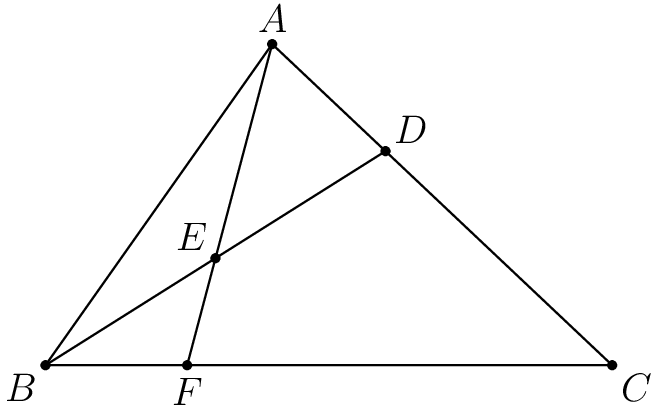
In triangle ABC , point D divides side so that AD:DC=1:2 . Let E be the midpoint of and let F be the point of intersection of line BC and line AE . Given that the area of is 360 , what is the area of ?
在三角形 ABC 中,点 D 把边分成的两段满足 AD:DC=1:2,点 E 是线段 BD 的中点,F 是直线 BC 和 AE 的交点。已知 ΔABC 的面积是 360,问 ΔEBF 的面积是多少?
- A.24
- B.30
- C.32
- D.36
- E.40
正确答案 · Correct Answer
B
解析 · Solution
解法1
先认清图:在 △ABC 中,D 在 AC 上把它分成 AD:DC=1:2,E 是 BD 的中点,直线 AE 与底边 BC 交于 F。要求的就是下图里上了色的小三角 △EBF。
下面四种解法由浅入深:前两种初中就够用,后两种是竞赛常备。四种殊途同归,都落到同一个数——[△EBF]=30。
解法1(常规解法·纯面积比)
全程只用一条工具:「两个三角形如果同高,面积比就等于底边比」(它们共用同一条高,面积只随底边长短变化)。
① 按 D 切:△ABD 与 △BCD 同高(都以 AC 上的一段为底、顶点同为 B)→ 面积比 = AD:DC = 1:2。总面积 360 → [△ABD]=120、[△BCD]=240。
② 按 E 切:E 是 BD 中点。在 △ABD 内,△ABE 与 △ADE 同高(顶点 A)、底 BE=ED → 各占一半 → [△ABE]=60;同理在 △CBD 内 [△CBE]=120。剩下 [△CAE]=360−60−120=180。
③ 求 F 把 BC 分成几比几:A、E、F 三点共线、F 在 BC 上,于是 「BF:FC = [△ABE]:[△ACE]」 = 60:180 = 1:3。所以 [△ABF] = [△ABC]×(BF/BC) = 360× = 90。
④ 在直线 AF 上定位 E:△ABE 与 △ABF 顶点同为 B、底 AE 与 AF 同在直线 AEF 上 → 面积比 = AE:AF = 60:90 = 2:3,故 EF:AF = 1:3。最后 △EBF 与 △ABF 同底 BF(在 BC 上),顶点 E、A 到 BC 的高之比 = EF:AF = 1:3 → [△EBF] = 90× = 30。
易错点:㈠ BF:FC 不是 1:2(1:2 是 AD:DC),实际是 1:3,必须由面积比 [△ABE]:[△ACE] 求;㈡ 求 [△ABF] 用的是 BF:BC=,不是 BF:FC=,这两个分母差一截,最容易写错;㈢「E 是中点」只在 △ABD、△CBD 内部各砍一半,不能直接对整个 △ABC 砍半。
巧解·质点法
质点法把「分点比」变成「挂砝码」:在线段两端各挂一个重物,平衡点(支点)一定靠近重的一端,所以 「支点到两端的距离比 = 两端砝码的反比」——本质就是杠杆原理 。
· AC 上 AD:DC=1:2:要让 D 成为平衡点,近的一端挂得重 → A 挂 2、C 挂 1(验证:2×AD = 1×DC 即 2×1=1×2 ✓),D 处合重 3。
· BD 上 E 是中点(BE:ED=1:1):两端等重 → B 挂的重 = D 处合重 = 3,E 处合重 6。
· F 在 BC 上:BF:FC = C 的重: B 的重 = 1:3 → [△ABF]=360×=90。
· A、E、F 共线:F 处合重 = B+C = 4,A 挂 2 → AE:EF = F 的重: A 的重 = 4:2 = 2:1,即 EF:AF=1:3 → [△EBF]=90×=30。
一组配重就把两个交点的比一起读出来,不必反复算面积——这正是质点法在竞赛里最值钱的地方。
梅涅劳斯定理
梅涅劳斯定理:一条直线截一个三角形的三边所在直线于三点,三段「分边比」之积 = 1。对 △BDC 取截线 A–E–F:
代入 BE/ED=1(E 是中点)、(AD 占 AC 的三分之一)→ CF/FB=3,即 BF:FC=1:3。
再补面积:E 是 BD 中点 → [△BEC]=[△BCD]=×240=120;△BFE 与 △BEC 同高(顶点 E 到 BC),底 BF:BC=1:4 → [△EBF]=120×=30。
坐标法·最稳最长
面积比与三角形形状无关,挑个最好算的直角三角形:A(0,0)、C(3,0)、B(0,h)。则 D=(1,0)、E=BD 中点=(, )。直线 AE:y=hx;直线 BC:。联立得 F=(, )。于是 [△ABC]=×3×h=,[△EBF]=(对 E、B、F 三点用鞋带公式),比 = ()÷() = → [△EBF]=360×=30。坐标法不依赖任何定理,但步骤最多;还没学直线方程的同学可以跳过。
前置(按需补):解法1、3 的地基都是「等高三角形面积比 = 底边比」,务必先吃透;解法2 要理解质点「反比」方向(重端靠近支点);解法3 的梅涅劳斯定理需先会背会用;解法4 要会两点定直线、联立求交点、用坐标(鞋带公式)求面积。
Solution 1
*(Elementary — pure area ratios.)* Here is the setup, with the target triangle shaded:
The only tool is: two triangles of equal height have areas in the ratio of their bases.
① Cut at : triangles and have the same height (same apex , bases on line ), so their areas are in ratio AD:DC=1:2. With total 360: [ABD]=120, [BCD]=240.
② Cut at : is the midpoint of . Inside , triangles and share apex with equal bases BE=ED, so each is half: [ABE]=60; likewise [CBE]=120. The rest is [CAE]=360-60-120=180.
③ How does split ? Since A,E,F are collinear with on , BF:FC=[ABE]:[ACE]=60:180=1:3. Hence .
④ Locate on line : triangles and share apex with bases AE,AF on line , so AE:AF=[ABE]:[ABF]=60:90=2:3, giving EF:AF=1:3. Finally and share base on , and the heights from and are in ratio EF:AF=1:3, so .
Common traps: BF:FC is , not (that is AD:DC); [ABF] uses , not ; and " is a midpoint" only halves areas inside and , not inside as a whole.
*(Slick — mass points.)* Mass points turn a division ratio into hanging weights: put a weight at each end of a segment; the balance point sits nearer the heavier end, so the distances from the balance point to the two ends are in the inverse ratio of the weights — this is just the lever law .
- On with AD:DC=1:2, put 2 at and 1 at (check: ); carries 3.
- On , is the midpoint (BE:ED=1:1), so equals 's weight =3; carries 6.
- on : , so .
- A,E,F collinear: carries B+C=4 and carries 2, so AE:EF=4:2=2:1, i.e. EF:AF=1:3, giving .
One set of weights reads off both intersection ratios at once — that is why mass points are so fast in competition.
*(Menelaus.)* Menelaus' theorem: a line cutting the three sides (or their extensions) of a triangle makes the product of the three division ratios equal to 1. Apply it to triangle with transversal :
With BE/ED=1 (midpoint) and , we get CF/FB=3, i.e. BF:FC=1:3. Then, since is the midpoint of , ; triangles and have the same height (apex above ) with BF:BC=1:4, so .
*(Coordinates — most reliable, longest.)* Area ratios don't depend on the triangle's shape, so pick a convenient right triangle: , , . Then D=(1,0) and E= midpoint of . Line : y=hx; line : . Solving gives . Now and (shoelace on E,B,F) , so the ratio is and . No theorems needed, but the most steps; skip if you haven't met line equations yet.
Prerequisites: Solutions 1 & 3 rest on "equal-height triangles have areas in the ratio of their bases" — master that first; Solution 2 needs the inverse-ratio direction of mass points; Solution 3 needs Menelaus; Solution 4 needs line equations, intersections, and the shoelace area formula.
继续练习